BEFORE YOU BUY ANY FRANCHISE!






This article covers many pertinent franchise topics such as
- Do Franchises actually work?
- What is the failure / success % rate of franchises across all brands?
- There's ONLY TWO reasons why Franchise Businesses Fail
- The advantages of Mobile Services vs Retail Franchise Brands
- 'Good' vs 'Bad' franchise models
- 'Good' vs. 'Bad' franchise prospects / operators
- What do you ACTUALLY get for the royalties (franchise fees) you pay?
- What do you get for the franchise fees you pay? If you're not receiving any benefits - Why pay them at all?
Do Franchises actually work?
The short answer is: Yes and No.
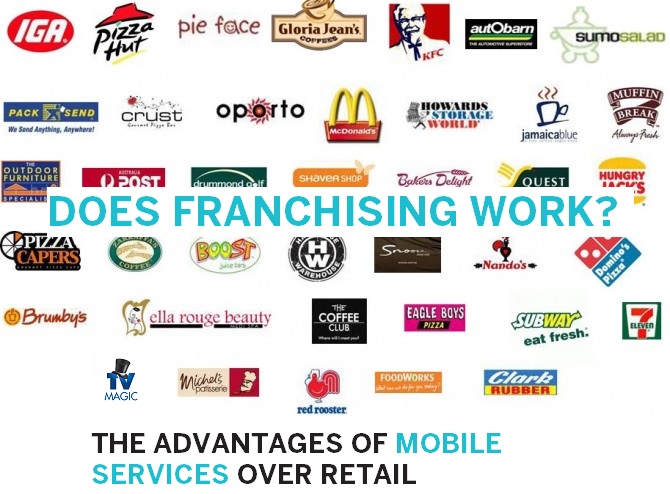
There are so many considerations and reasons behind any possible answers.
The answer could be a yes and the answer could be a no.
But lets assume for a second that what you're actually meaning to ask is:
"Is there a strong LIKELIHOOD that I will be profitable and successful in a particular franchise?
Will I have a better chance of success and make more profit in a franchise or am I better off trying to do it on my own?" - VERY DIFFERENT QUESTION!
Lets assume that you mean to ask that question.
To which the answer is - "It Depends on which franchise system you get into!"
You see, the answer requires a little explanation into many, many topics and factors. If it was possible to boil down all of those factors into 2x major categories it could be categorised as follows:
- What a successful franchise model SHOULD look like and what it SHOULDN'T look like,
- Qualities of the franchise buyer - Who is the franchisee who bought the business? - are they a person that should get into business?
Yet again, we need to make another assumption to answer this question. As, a clear 2x 2 matrix has been proven time and time again: - The most brilliant person in the world can fail in a poor franchise business model just as much as the most 'hopeless' person in the world can fail in a very strong franchise business model; and the most brilliant person can equally, succeed in a poor franchise business model only as much as the most 'hopeless' person's success in a very strong franchise business model. (A typical 2x 2 matrix)
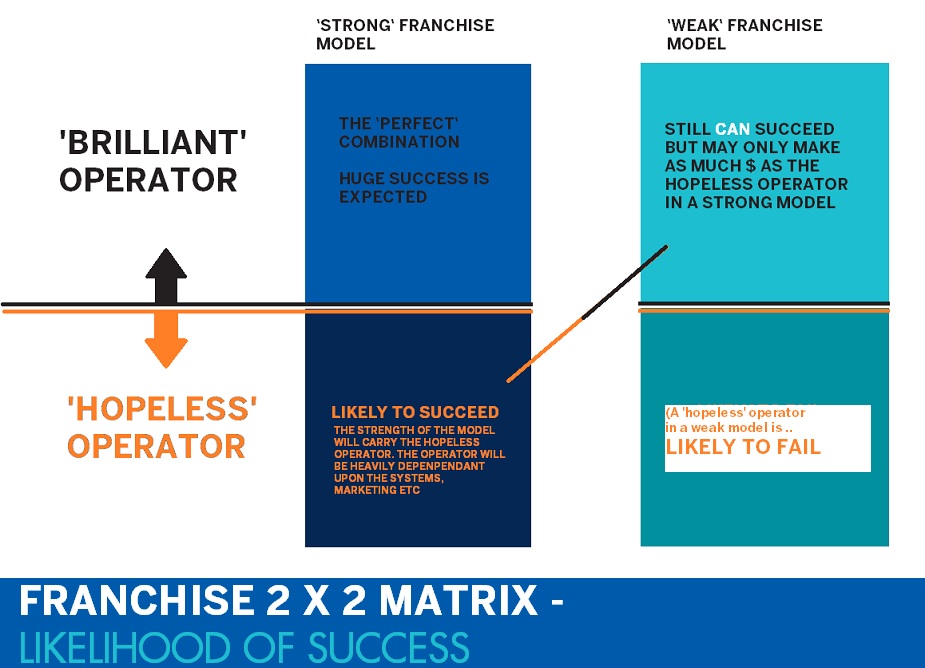
For the sake of explaining "Do franchises actually work?" lets ignore #2 topic (the whole " Should I even be getting into business?") and assume that the person is not the factor. Lets assume the person in question possesses ALL the necessary and basic apptitude, willingness and min. learning ability that any other human who has ever started or run a successful business...and now we are talking about the LIKELIHOODihood of what success they will have - depending on the franchise business model.
Franchising began in American in the 1850s. It was designed to be a means of doing business to rapidly grow a brand with the intent of achieve a "win - win - win". That is a win for the customer ( end user) a win for the franchiseee and a win for the founder / brand owner (the franchisor). Franchising was very successful and brands that come to mind include the McDonalds and KFCs of the world.
There are some 15,000-ish franchise brands around the world and Australia is home to 1200-1300 of them. Out of those 1200 odd franchise brands - Australian franchisors often talk about the 'parasytical' brands and then the 'good brands'. In Australia, we speak of the 'good force' and a 'bad force' in franchising. Unfortunately 50% of Australian franchise brands give franchising a bad name and as for the other 50% they have alot of many successful and very happy franchisees however, they are sick of the brands that a ruining it for everybody else. In the franchise sector we talk about this because just about all of us have met someone who has been burned by franchising or heard "some story" and this niggly little piece of hearsay can cause enough doubt to the most brilliant of people who then decide not to back themselves. These prospects may possess all the basic skills and are very capable of being successful in a franchise business but what choose not to back themselves and decide not to buy a franchise because of what their uncle, aunt, friend of a friend of a friend said etc.. and the story is told without context or the right information.
There are only two reasons why franchise businesses fail

Before we explain those two reasons; it must be said that statistically franchising has a much higher % of success rate (than non-franchised businesses) including the, "not so good" franchise models.
It has been reported that over 80% of businesses fail within their first 12 months...(non-franchised)
..and of that remaining twenty percent .. 90% of those are no longer around 5 years later.
In franchising however, you can nearly invert those statistics. Flip that on its head.
The statistics in franchising were that 80% of start ups succeed and only 20% fail.
If twenty(20) % of franchise startups still fail, why?
Why isn't it 100% success?
Here's why..
"WHAT ARE THE TWO REASONS BEHIND THOSE FAILING 20%? "
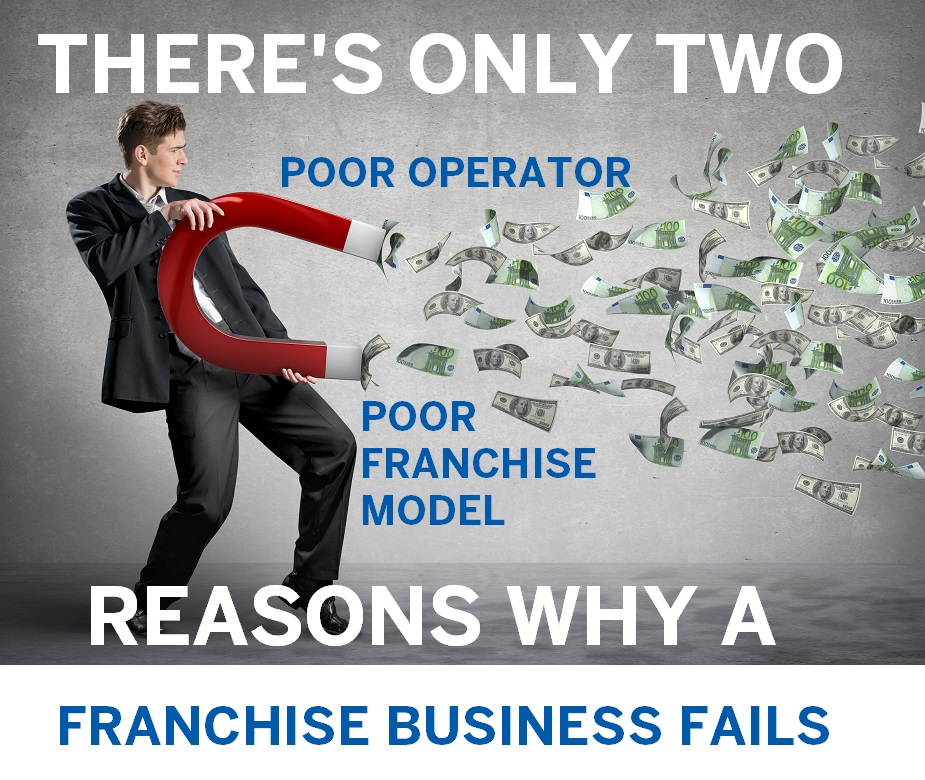
There are only two reasons why franchise businesses fail
- The failure of the business came down to the franchisee not following a system (usually due to personal setbacks / circumstances that are often unrelated to business- think poor health, relationships etc) .. and they would have equally failed had they had a non-franchised business;
- They invested in poor franchise business model - statiscally and mathematically the model was designed to reward the franchisor more than the franchisee. The expectations were unrealistic, there was a lack of support/leadership, inadequate training or poor site selection etc
About #1 - Every Good Franchise Brand does its best to filter out poor candidates - Poor Franchise models say "yes" to anyone who will write them a cheque.
Many of the 'good franchisors' have had their fair share of speaking to prospects who have an opinion on franchising. When the question is asked: "Does franchising work?" or "What makes you any different to any other franchise brand?" We understand that what they are really asking is (that they are unaware of is) "Is the franchise brand I am enquirying about a "Good egg" / "a good opportunity" or is it a "bad one"?
The answer to this question is simpler than you might think - Does the franchisor "give a shit" or don't they? Do they believe in the whole concept of franchising - the "win / win / win" concept? For if they do, this automatically & dramatically increases the LIKELIHOODihood of providing a successful business model for you as a prospect. You see, mathematically it doesn't matter what the start up costs or ongoing fees are.. every industry is different. For example if a business costs just sixty-three dollars ($63) and you are GUARANTEED an income of two-hundred and fifty dollars($250) profit per year .. by definition and technically that's a successful, profitable business! Or if a business had an entry level of $1million and in the purchase of the business you are guaranteed $15million in annual revenue and the ongoing fees are $14million every year... (so you only got to keep $1million out of $15mil you make) you still have a $1million per year profit lets say) - by definition that's success too! and very attractive! The problem is.. some franchisors care more about the money they're going to make - more than their people and their success. THIS IS A HUGE PROBLEM.
Where everything falls apart is when we talk about LIKELIHOODS and the 'greed factor' of a franchisor. For some new franchisors they don't know what they don't know .. and they "accidently" have a poor business model (of course they believe it's great and will sell you "on how great it is"). What you may not know is that some of the MOST SUCCESSFUL FRANCHISE BRANDS IN THE WORLD didn't sell their first franchises! They actually granted their first bunch of franchise stores / units for free and made OUTRAGEOUS GUARANTEES and RISK NUETRAL GUARANTEES because they cared MORE about the reputation more about their customers and people; than the gain of one extra sale. They matured and perfected their business model first - before they went to market and started selling franchise territories. They essentially earnt their stripes /badges by way of sacrifice; by proving their concept over a minimum of a dozen franchisees (whom didn't reward the franchisor much in the beginning) before they then started to sell the franchise for what it was really worth. If there was one way to learn about what the opportunity you're considering getting into it's to ask the following two questions 1. How they started and 2. Is what they're doing now the same as what they did in the beginning? Or are you now being squeezed into an oversaturated brand?
Please note: The Psychology behind "Over-saturation" is one that must be backed by facts and real statistics. It is true that a brand can expand and grow the more it saturates the market... this growth however usually reaches a point (at some stage) where each extra echelon of growth or extra branch opening - stops having the same efficiency - this is know as the LAW OF DIMINISHING RETURNS. If you've invested into a franchise system at that time; the only efficiency you're likely creating is growth for the brand name - not for your pockets. The strong franchise brands of Globe are aware of 'Over Saturation'.. unfortunately it would seem that only 50% of franchisors are aware (or care) about over-saturation.
Why is it that they don't care? No doubt all franchisors want to grow .. the more they grow .. the bigger the brand becomes. What's often ignored is- with that growth; comes the potential to hit that ceiling of diminishing returns. That's why we are constantly looking for ways to grow and augment the business model internally or diversify into other income streams within the same model - to enable 'deserved growth' and the right to sell extra / divide territories. If a franchisor is not doing that:- They may just be giving franchising a bad name. If the rate of franchisee success is not over 80% - the model is not providing any real reason why a franchise prospect SHOULD invest in their model as opposed to trying it on their own. For Australian franchise brands - that's why some of the BEST - "GOLDEN" OPPORTUNITIES to get into a franchise system is to choose one that has between 20-60 franchisees. Your investment is low risk because it would be deemed that the franchise is very successful (they have a minimum of 20 x proven cases) and you're not entering into an over-saturated franchise brand. The only other GOLDEN OPPORTUNITY is where you are considering a very well established franchise brand and a TERRITORY RESALE opportunity comes up; and you're buying an already-established business within a strong network. Please note: The topic of 'over-saturation' predominently applies to metropolitan / larger towns/cities. If you are in interested in taking a franchise concept into any new, regional area - do not be as concerned about over-saturation. Do not ignore it completely! But do not be "as concerned". The question/s you should ask your potential franchisor is - how many other territories are available for sale around me? And will I be the only one? OR will I potentially be sharing this (x area) with future franchiseees?
Where many new Franchise founders fall short, is that they can too much emphasis on the profits and not on what the concept / brand was meant to stand for. The scales are too far tipped towards putting money in the bank and not enough counter weight on the value provided for its franchisees or for the end user (customers).
In franchising you're not deemed proven / successful by banks / other franchise brands until you hit that magic number of 15x franchisees.
These new franchisors often think that they've done all the work building their successful business model and now they are just thinking about selling the concept over and over again and 'gettting paid forever for it'.
In any (most franchises) you will have a franchise fee "royalty" and this is paid regardless of your franchise business being a success or a failure or not. One thing that TV Magic and many of the 'good forces' of franchises think about is : well we don't actually deserve that royalty unless we're providing value! We recognise that if we are privileged to have a franchsiee invest in our brand.. we recognise that they could equally go out there and attempt to start the business themselves! So the BIG QUESTION is - what does the royalty give me? Is value stacked so high in exchange for that royalty/ franchisee fee that they would be nuts to not pay it? ?? ooorrr are they better off going out on their own ? - because going out on there own would mean they would save that $$ and earn more? If you don't know the answer to that question and you're considering any franchise then perhaps you should think twice about the franchise model you're investing in! We tell you this - not because we want to risk convincing you NOT to buy one of our franchise territories.. but because we MOST DEFINITELY don't want you to buy one of the "bad franchise brands" where you'll become another 'statistic' that's adding to the mass consciousness that "franchising is not a good idea!"
The attitude we have is simply this: - if the franchisee would genuinely earn more by going out on their own... why do we have a fee to begin with!? The whole idea is help people.. it's what the franchise brand stands for right? Having a successful model that people can tap into? and there's a genuine HIGH PROBABILITY that they will succeed! Because the franchisor isn't greedy, the fees are providing value in many forms that help the business make EVEN MORE IN COMPARISON (to going out on their own) and the VALUE OUTWEIGHS its own expense and 100% NEGATES / cancels out the "expense of paying the fee" in the first place! Otherwise, why have it!!!??
GOOD FRANCHISE BRANDS are built on a small fee / small % of the entire Franchise network.
It's no illusion that any business owner on the planet has to reinvest back into their brand new business. If you don't you'll probably fail. That learning curve and the cost involved comes in the form of many, many mistakes and lessons learned. When you join a mature franchise business model (and one that is not over-saturated) and one that "gives a shit" and one that believes in the "win - win - win"concept; you have the advantage that every other person who "tried it on their own" doesn't have and that is maturity and wisdom on your side. You have a support team that you can go to and ask "Do you think this is a good idea?" and with experience and convinction they should be able to answer you very quickly with answers such as "Absolutely, we recommend you do that! That will give you a return!" or " No, chances are that will be a waste of money! .. we've done that x times before and we've already learnt that lesson for you" etc.. That in itself can be worth all the fees you pay!
If there aren't at least 10 x "value adds" that you are receiving as a direct benefit from the franchise royalties you pay - Why are you paying them to begin with?
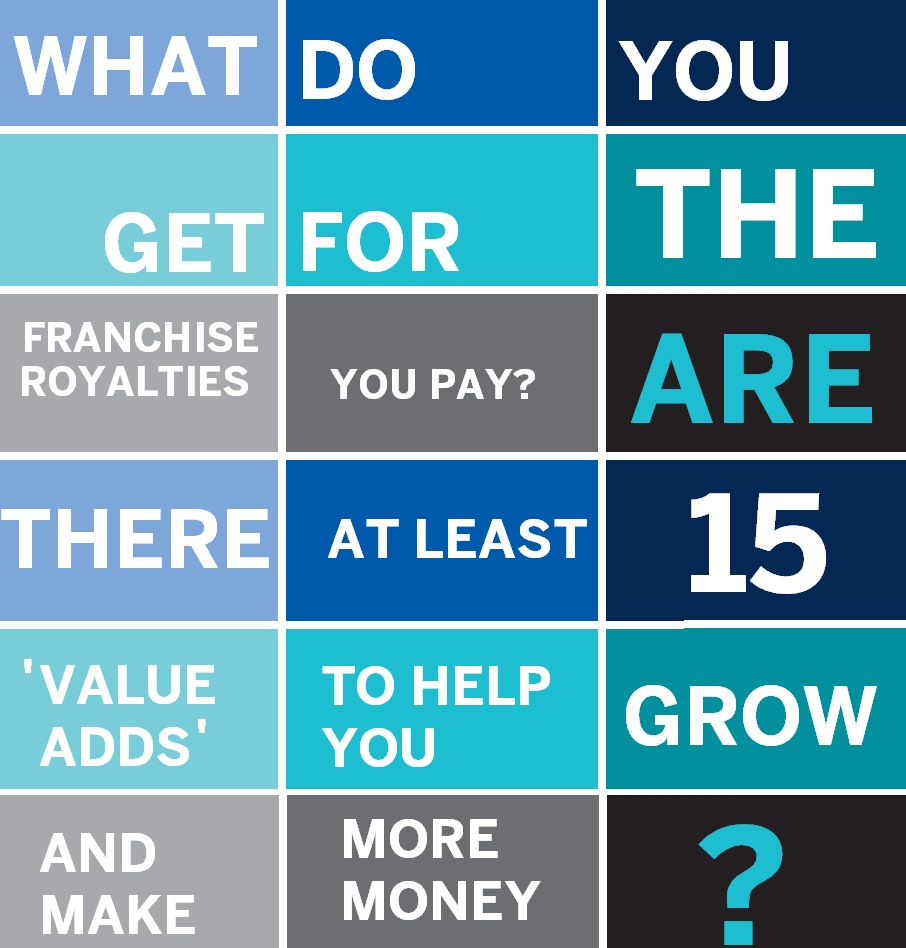
Other powerful ways that you can leverage off a proven and matured franchise business model include:
- Bulk buying power (products / materials / software / etc)
- Marketing Saturation
- Increased brand awareness (Reputation and 'good will' is not built over night - it has been said, that it can take a decade)
- Internal Marketing Teams - (again, utilises 'bulk buying power' - if you had your own marketing employee you'd have an addtional $50k - $250k expense)
- Shortcuts to growth, avoiding possible pitfalls and setbacks
- Ongoing Support, Training & Business Coaching that would cost you time and money + cost of mistakes and lessons learnt
- Internal Support from your franchise peers .. Hey if you're on you're own .. all your competition aren't going to give you their 'secret herbs and spices' or go out of their way to help you! In a strong franchise culture however,.. you may have "a dozen best friends" who are not competing with you directly but work directly and understand your business (because they also run your exact business- just in another city) and they are helping you because they know one day your brilliant idea might help them make money. A good franchise culture shares these best practices. Now if you were on your own.. the probability that you will suffer from what most entrepreneurs is very high! They suffer from a what's known as plateau-ing or ( hitting a 'ceiling'). For the entrepreneaurs that don't plateau or hit ceilings; THEY ARE SPENDING MONEY ON COACHING AND MAKING MISTAKES AND LEARNING LESSONS!! (and often twice as costly!) .. When you have coaches and peers that are directly in your business model (but not competing with you however) and you see them constantly breaking records; it not only shows you "it can be done" but FEELS REALLY GOOD when you can shamelessly ask for help "hey! How did you do that?" and they'll happily share away! The end result is something that looks like year on year on year growth! It has been said and it's true... A franchise brand grows; all its independant parts grow with it (like a rising tide). Strong franchise brands are constantly reinvesting the royalties you pay back into the business. They are constantly improving, re-inventing and making the sure the businesses/s services /products stay relevant and current. This is done with leverage, experience and maturity. (You really won't have time for it) and because the process is leveraged it costs a whole lot less than if you were to do it.
- Fast-track your learning curve / start up time - So the money you are making would be the equivalent of you with 5 years experience ( if you went out on your own).
- Premium branding / marketing attracts higher paying / premium customers
- Effective marketing = Higher number of leads
- Proven scripts and business processes (chances are, a strong franchise model has tested 1000 x of your 'best ideas' already; and has factual statistics as to "what actually works best") The scripts have also been tested across much larger samples - this basically means even higher returns
- National strategic relationships .. If you are a small business- you're not always invited to go door knocking asking "can you give me a try" vs a national franchise brand that reverses that relationship into a relationship that feels more like "they need us more than we need them" type of relationship and this naturally has more negotiating power which means more money / profits for you.
- Solutions for just about every business problem you'll ever face without it costing you as much time / money / stress. Business is hard enough as it is! Tax, paperwork, relationships, customers who don't pay, bad employees, the list is endless .. if you have a team that can do it in their sleep and support you.. you really can't put a price on that support! Most good franchise brands just do this and it's just "part of what they do"
- INNOVATION & Infrastructure that would be out of your budget if you were a starting out on your own. A typical example is TV Magic's No CALL CENTRE franchise business structure. This struture was pioneering in 2013 when it was launced and as of 2025 many other man in a van franchises are still behind the ball, playing "catch up" - trying to compete.
- Software ADVANTAGES A typical example is the TV Magic CRM (Over $500,000 & 13+ years in I.T development of our own tailor-made business software) and our NO CALL CENTRE business model. We challenge you to find one other Mobile Service Franchise that successfully runs a nationwide operation, can monitor and assist franchisees all over the country but does not have a centralised lead generation/ marketing funnel!! You won't find it! You see every single one of the 400-650 customers that call national franchise - TV Magic , the customers call the franchisee direct, they are calling the local guy directly ..on their mobiles and yet we still have full access and control and visibility to all this actively from head office! This is only possible with our CRM software! There's nothing on the shelf that anyone can buy that can do what our software does! It cannot be replicated! IT cannot be bought .. it's built purposely for TV Magic and the only way would be if another company actually built something from scratch and attempted to replicate it! But because it's not accessible to anyone .. they don't even know what they are copying!
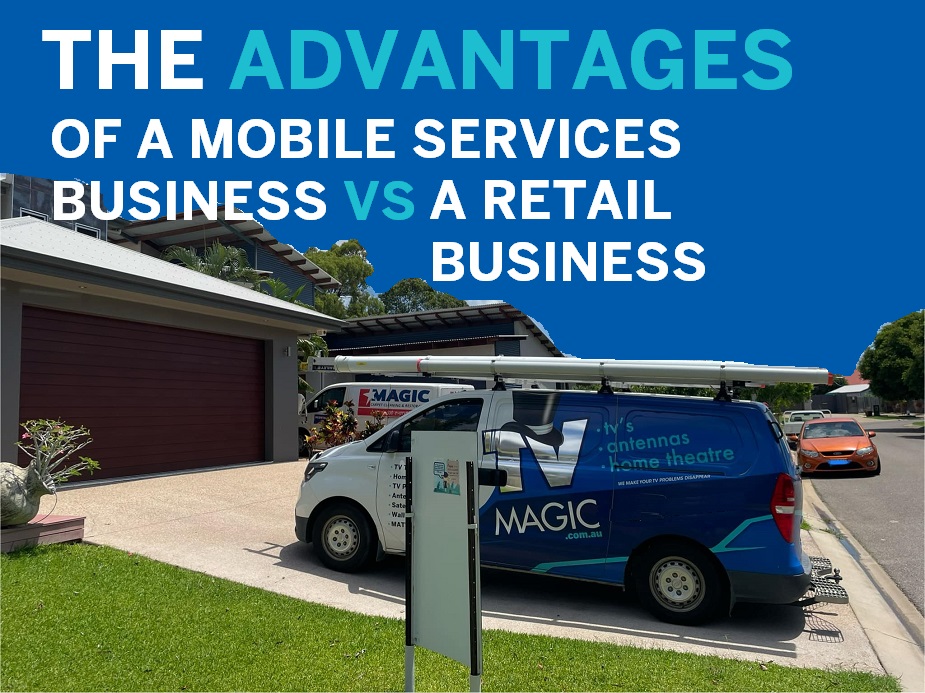
What are the advantages of a mobile services business?
Why are mobile services dominating and are the most lucrative businesses in australia and america?
 T
T
To state the obvious - the overheads of a mobile services-based business are so much lower
- In retail you are often relying on foot-traffic. Your business may also have limited by parking, restrictions on how much signage space you are allowed to utilise and many other factors. The enormous rental / lease fees you pay are going towards the space / land you operate your business on. The real estate that owns that land / space are also trying to maximise profit. It is not uncommon for a restaurant or clothing store to only break even on day 25 of the month (and therefore they are only profiting 5 days of the month of their sales).
- With "Man in a Van" type businesses/ franchises your only start up costs are a vehicle (usually $50k-$100k)- vs. fitting out a store (usually in the hundreds of thousands $). The ongoing costs of your store can be $2000- $20,000 per week where as the ongoing costs of a vehicle will be only petrol, registration, insurance and maintenance (or car payments - if you don't own it outright). The cost of your business vehicle will be $50-$250 per week in comparison to $2000- $20,000 per week if you have a restaurant or retail type business.
- Next - Retail / restaurants usually have Staff! - The cost of staff and employees.
- In your mobile services business - (even if you grow) - you may have a maximum of 1-5 staff - compared to 5- 50 staff for a restaurant / retail business model
- Retail business models will definitely do many more transactions per day than mobile services - between 10-10,000 per day. However their margins are usually small - $5 profit per transaction to $500. With 90% of all transactions under $50 profit per transaction
- In Mobile service based businesses (In Australia or Amercia) you may only do 1-10 transactions per day. However you will probably recieve a min. of $100/hr up to $1000 per hour depending on the industry, and products/services provided.
- It's because skilled labour in Australia pays so well you will find the average tradie can out-earn the average subway store owner (example). Did you know the average subway store owner only earns $60k p.a! This means that a Subway franchisee must own 3 x stores to make a decent living! Now they've invested $900k to $1.5mil but they are still (in Subway's eyes) making a good living because if each store pays itself off - within 5 years - they consider that a good investment!! (Compared to what!?) Compared to investing into real estate the say. "The average houses doubles every 10 years. The average subway store will double every 5 years" Many franchise business owners agree that 5 years is not a good return! If you can get into a franchise where you are likely to have the business paid off in 12 months or under - that's a solid franchise investment to get into!

More Info


SUBMIT YOUR EXPRESSION OF INTEREST BELOW


 1800 TV MAGIC